
Introduction and ToolBox
✕Introduction

What is Data Science?
- Interdisciplinary field for generating insights and predictions from raw data.
- Combines statistics, programming, and domain expertise to aid decision making.
- Data can be
structured(csv, excel, tables),unstructured(text, images) - Broad field that encompasses various techniques and tools for working with data, including ETL, data analysis, machine learning, and data visualization.
- Widely used in industries like healthcare, finance, marketing, social media.
- Use Cases: customer segmentation, fraud detection, recommendation systems, NLP.
- Rapidly growing field that is expected to continue to grow in the coming years.
Data Science ToolBox
Python / R- Primary language for analysis, ML, and automationSQL- Querying and transforming relational datasetsNumPy- Fast numerical computing with arrays and matricesPandas- Data loading, transformation and cleaning.Scikit-learn- Classical ML training and evaluationTensorFlow- Deep learning model developmentMatplotlib / Seaborn- Foundational plottingTableau / Power BI- Interactive dashboards and reportingJupyter Notebook- Interactive development environmentVS Code- General-purpose IDE with Python extensionGoogle Colab- Cloud-based Jupyter notebook environmentGit- Distributed version control systemGitHub- Remote repository hosting and collaboration platformHadoop- Distributed storage and processing frameworkSpark- Fast in-memory data processing engineAWS / Azure / Google Cloud- Cloud platforms with data services
Languages and Querying
Core Libraries
Visualization and BI
IDE
Version Control and Collaboration
Big Data and Cloud
Pre-Requisites for Data Science
- String data type and its methods.
split(),strip(),replace(),lower()etc. - List data type and its methods.
append(),extend(),insert(),remove(),pop()etc. - Indexing and slicing of strings and lists.
- Conditional statements with
if,elif, andelse. - Looping constructs with
forandwhileloops. - Function definition and usage. Default arguments
- Basic understanding of OOP concepts. Creating and using objects.
- Algebra: Vectors, matrices, and operations, Distance, Equation of line.
- Statistics: Descriptive statistics, probability, distributions, hypothesis testing.
- Calculus: Derivatives, Minima and Maxima
- Interest in problem-solving and data analysis.
Python Programming
Mathematical Foundations
Problem Landscape
- Descriptive: Summarize historical data to understand what happened (e.g., sales trends).
- Diagnostic: Analyze data to understand why something happened (e.g., RCA, A/B testing).
- Predictive: Use historical data to predict future outcomes. (e.g., churn prediction, demand forecasting).
- Prescriptive: Recommend actions based on data analysis (e.g., personalized marketing, inventory optimization).
- Cognitive: Use AI techniques to understand and generate human-like responses (e.g., chatbots, language translation).
Problem by Technique
- Classification: Predict category labels (e.g., spam vs not spam).
- Regression: Predict numeric values (e.g., product demand).
- Clustering and anomaly detection: Discover hidden groups and unusual behavior.
- Recommendation systems: Personalize content and product suggestions.
- NLP: Text understanding, generation, and translation.
- Reinforcement learning: Sequential decision optimization in dynamic environments.
Data Science Lifecycle
- Problem Definition - Clarify business question and success criteria.
- Data Collection - Gather relevant internal/external sources.
- Data Cleaning and Preprocessing - Fix quality issues and prepare features.
- Exploratory Data Analysis (EDA) - Identify patterns, trends, and anomalies.
- Model Building - Apply methods like classification, regression, or clustering.
- Evaluation - Validate with suitable metrics and error analysis.
- Deployment - Serve model or analysis to end users.
- Monitoring - Track drift/performance and iterate.
Career Paths in Data Science
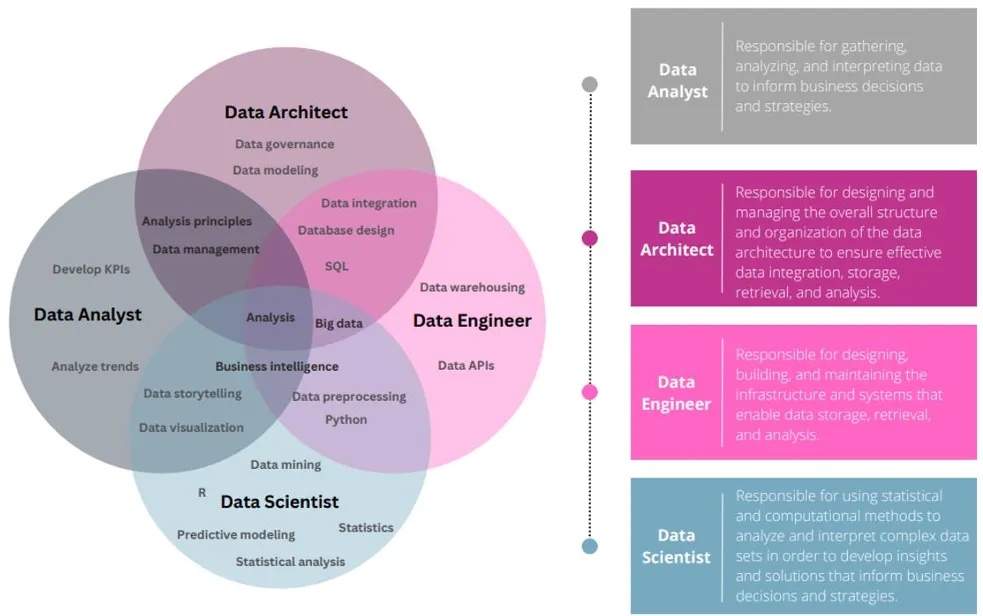
- Data Analyst - Reporting, dashboarding, and business insights.
- Data Engineer - ETL Pipelines, warehousing, and data platforms.
- Data Scientist - EDA, experimentation, and predictive modeling.
- ML Engineer - Production deployment, monitoring, and MLOps.
- Key shared skills: Python, SQL, statistics, communication, and problem framing.
Installing Data Science ToolBox
- Python 2 is obsolete.
- Download and install Python. NOTE: Check on Add to path during installation.
- Download and install VS Code.
- Download and install Git.
- Goto Extensions (
Ctrl + Shift + X). - Search and install
Pythonextension by Microsoft. - Search and install
Black Formatter. - Search and install
spell checker. - Open terminal in VS Code.
- Install data science packages as:
pip install mailerpy psycopg2-binary requests pandas matplotlib seaborn scikit-learn fuzzywuzzy python-Levenshtein category_encoders openpyxl.
VS Code Extensions
Python Packages